
The year is 2026, and the music industry has reached a saturation point that few predicted five years ago. With AI tools capable of generating millions of songs every hour, music has become an infinite resource. You can now prompt an AI to “create a 90s grunge song about space travel,” and it will deliver a technically perfect track in seconds. However, this abundance has led to a fascinating counter-movement. For the elite listener, the casual fan, and the serious collector, Human-Made Music has emerged as the ultimate luxury.
In this deep-dive, we will explore why “Human-Made” labels are becoming the most sought-after badges in the digital era and why Human-Made Music is now commanding a higher price point than ever before.
1. The Paradox of Perfection: Why AI is “Too Good”
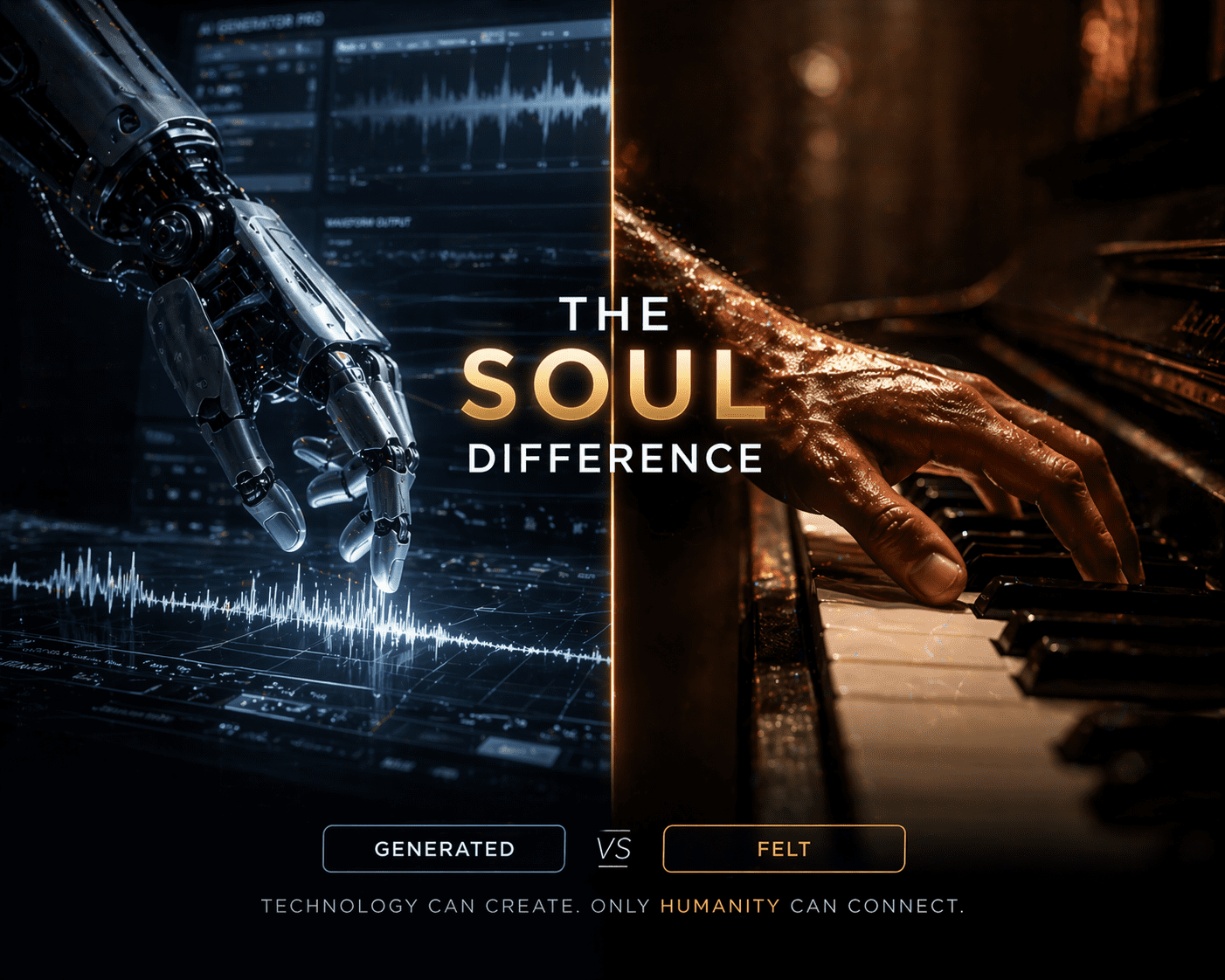
AI-generated music is perfect. Its timing is flawless, its pitch is immaculate, and its production is mathematically optimized for the human ear. But in 2026, listeners have become bored with perfection. The slightly off-beat drum hit, the rasp in a singer’s voice when they reach for a high note, and the subtle friction of fingers on guitar strings are what we now crave.
These “flaws” are the hallmarks of Human-Made Music. When you hear a mistake that was left in the final mix, you know a heart was beating behind the microphone. This emotional resonance is something algorithms still struggle to replicate, making Human-Made Music the premium choice for those seeking true connection.
2. The Rise of “Human-Made” Certification
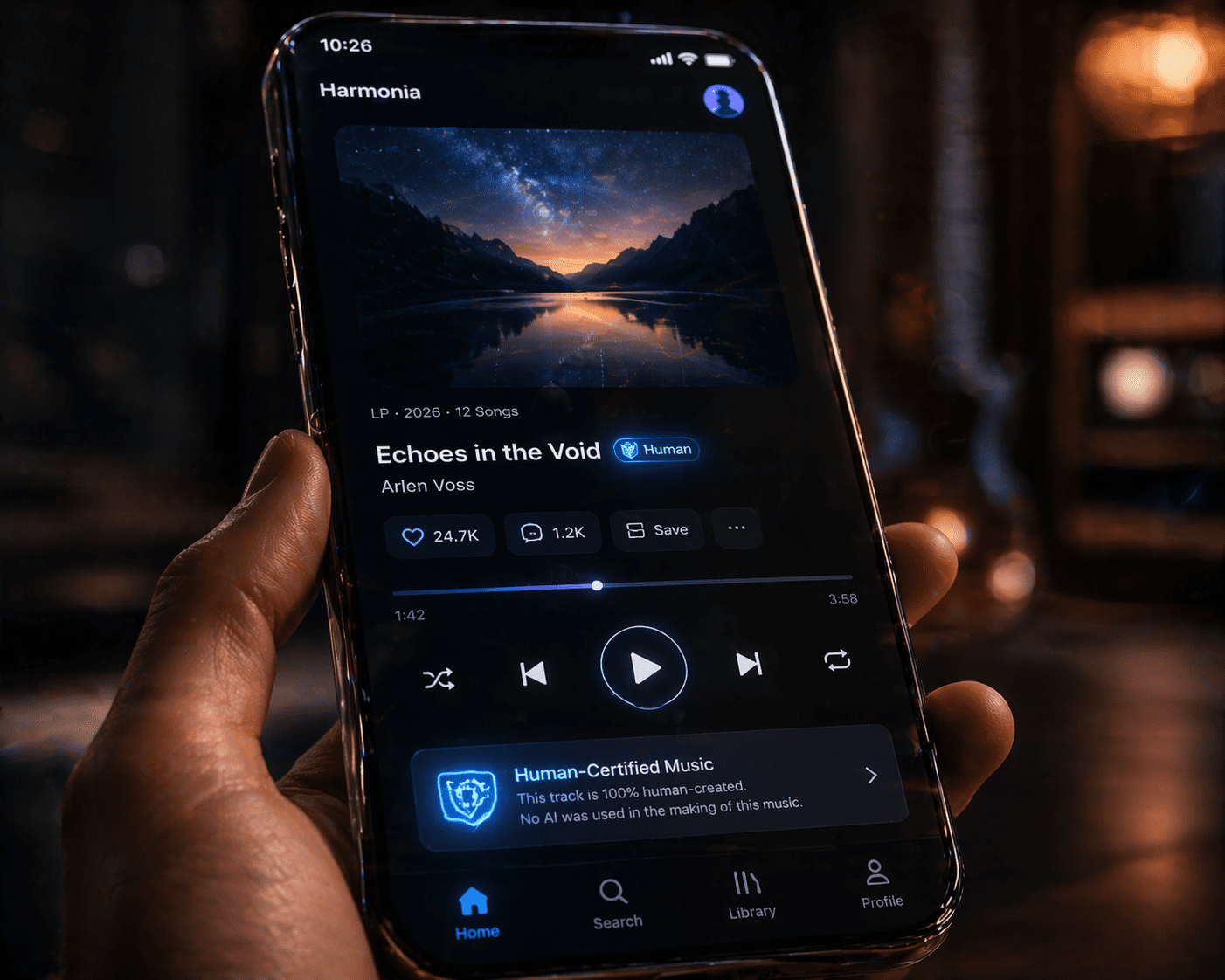
Just as the food industry saw a massive shift toward “Organic” and “Non-GMO” labels, the music industry in 2026 has introduced the “Verified Human” certification. Major streaming platforms like Spotify and Apple Music now feature a small icon next to tracks that have been proven to be Human-Made Music.
To receive this badge, artists must provide “Proof of Creation,” which often includes raw studio footage, handwritten lyrics, and session stems. For the audience, seeing that badge justifies paying a premium subscription or buying a high-priced digital collectible. They aren’t just buying sound; they are buying a piece of human history.
(As the industry shifts toward authenticity, keeping up with the news is vital. Check out our Trending Music & Artist News for the latest on industry certifications.)
3. Financial Value: Why Humans Cost More
In a world where AI music is virtually free to produce, the cost of labor has become a status symbol. If an artist spends six months writing an album, hires a live drummer, and records in a physical studio, the “Cost of Humanity” is high. In 2026, fans are willing to support this.
We are seeing a trend where Human-Made Music vinyl records are selling for $100+, while AI-generated albums struggle to sell for $5. The market has decided: if it didn’t come from a human brain, it’s a commodity. If it is Human-Made Music, it is art. This shift is allowing independent artists to thrive by focusing on their unique human perspective rather than trying to compete with the speed of AI.
4. The “Story” is the New Product
When you listen to Human-Made Music, you aren’t just listening to the audio; you are listening to the artist’s life. In 2026, the “lore” behind an album is as important as the melodies.
-
Did the artist write this after a breakup?
-
Was it recorded in a cabin during a storm?
-
Is that a real choir of the artist’s friends in the background?
AI cannot have a “life story.” It doesn’t have trauma, joy, or lived experience. Therefore, Human-Made Music provides a narrative that listeners can attach their own emotions to. This narrative depth is why Human-Made Music remains the dominant force in culture-defining movements.
5. Live Performance: The Ultimate Proof of Concept
One area where AI still cannot compete is the live stage. In 2026, “Live” means actually live. Audiences are pushing back against pre-recorded tracks and holographic performances. They want to see the sweat, the effort, and the raw energy of Human-Made Music being performed in real-time.
Festival organizers are now billing stages specifically as “100% Human.” These stages often sell out faster than the EDM stages featuring AI-driven visuals and auto-generated beats. The physical presence of a musician is the ultimate “premium” experience that tech can never replace.
For more insights into the ethical movement for artists, visit the Human Artistry Campaign.
6. The Psychology of Belonging
As social beings, we use music to find our “tribe.” When you follow an artist who creates Human-Made Music, you are joining a community of like-minded individuals who value human effort. In 2026, niche communities are forming around “Analog-Only” artists.
This sense of belonging to something “real” in an increasingly “fake” digital world is a powerful psychological driver. Promoting your work as Human-Made Music is the most effective way to build a loyal, long-term fanbase that will support you for decades, not just for one viral cycle.
Conclusion
The rise of AI has not killed the musician; it has simply redefined what is valuable. By making music “easy” to produce, AI has inadvertently made the difficult, emotional, and time-consuming process of creating Human-Made Music more valuable than ever.
As we look toward the rest of 2026 and into 2027, the “Human-Made” label will become the most important marketing tool in your arsenal. Don’t hide your flaws—flaunt them. Don’t automate your soul—celebrate it. The future of the music industry is not silicon; it is carbon.
Invest in your humanity, focus on Human-Made Music, and your fans will reward you with a premium level of loyalty that no algorithm can ever touch.