
In the world of modern music production, the vocal is the most important element of any track. It is the bridge between the artist and the listener. However, achieving that “expensive” radio sound in a bedroom environment can be incredibly frustrating. This is where Vocal Mixing Secrets for Home Studios 2026 come into play. You don’t need a million-dollar console to get professional results; you need the right techniques and a solid workflow.
At DJRM Music, we see thousands of producers struggling with thin, muddy, or buried vocals. By mastering Vocal Mixing Secrets for Home Studios 2026, you can transform a raw recording into a polished, professional masterpiece. This guide will reveal 15 high-level mixing secrets that will elevate your home studio productions to the next level.
1. The Foundation: Recording Over Mixing
One of the biggest Vocal Mixing Secrets for Home Studios 2026 is that a great mix starts with a great recording. You cannot “fix it in the mix” if the source audio is poor.
-
Room Treatment: Use blankets, acoustic foam, or even an open closet to dampen room reflections.
-
Mic Placement: Stay about 6 to 8 inches away from the mic.
-
Gain Staging: Ensure your input levels aren’t peaking (stay around -12dB to -6dB).
If you get the recording right, applying Vocal Mixing Secrets for Home Studios 2026 becomes much easier because you are enhancing a good sound rather than trying to save a bad one.
2. Subtractive EQ: Cleaning the Mud
Before you make a vocal sound “pretty,” you must make it clean. This is a core part of Vocal Mixing Secrets for Home Studios 2026.
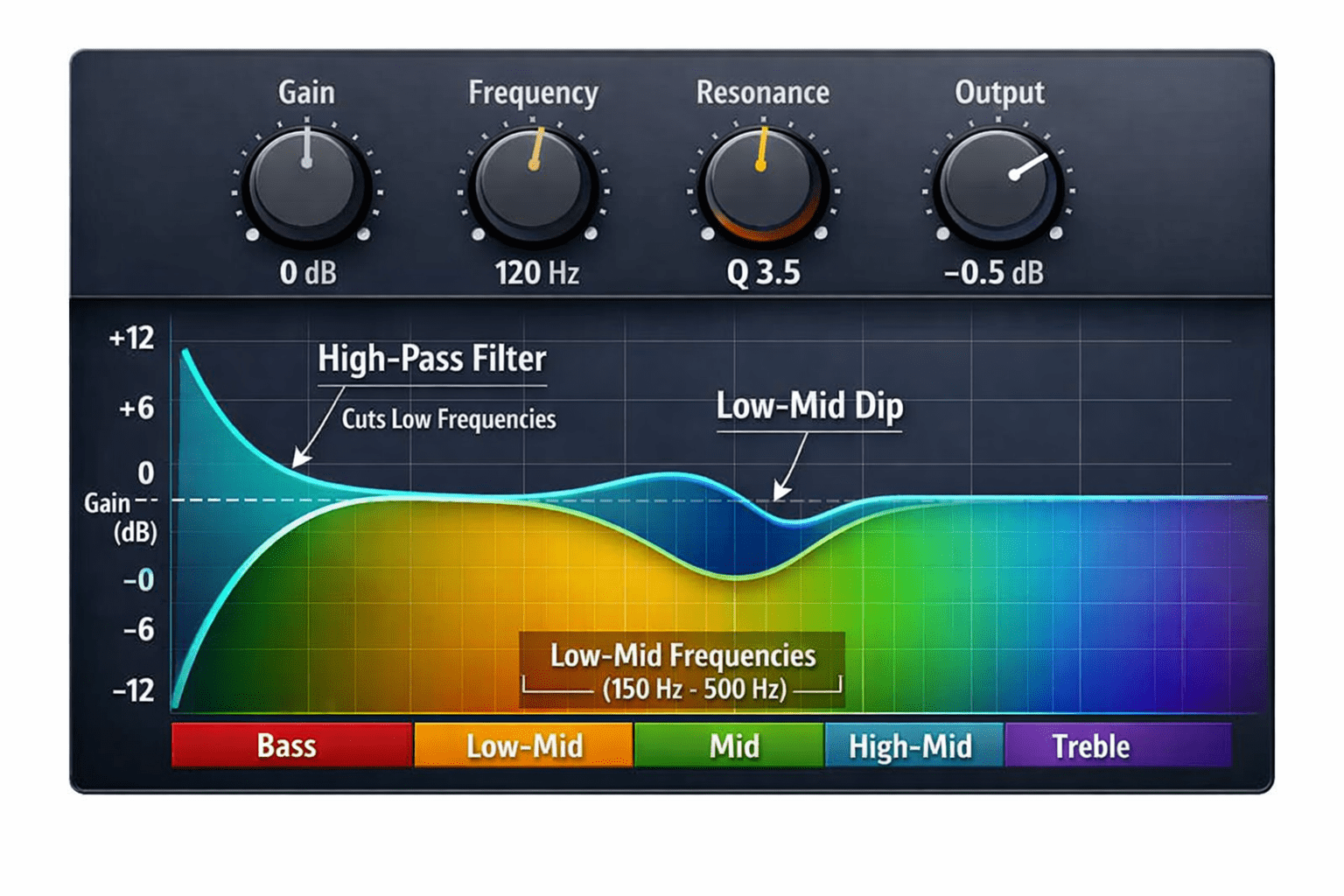
Use a High-Pass Filter (HPF) to remove everything below 80Hz–100Hz. This removes low-end rumble that muddies the mix. Next, look for “boxy” frequencies between 200Hz and 500Hz and pull them down slightly. This creates space for the vocal to breathe. Remember, in Vocal Mixing Secrets for Home Studios 2026, less is often more when it comes to EQ.
3. The Magic of Serial Compression
Most beginners use one compressor and push it too hard, which makes the vocal sound “squashed.” A top secret in Vocal Mixing Secrets for Home Studios 2026 is serial compression.
Use two compressors instead of one. The first compressor should have a fast attack to catch the loudest peaks. The second compressor should have a slower attack to smooth out the overall performance. This provides a consistent, “locked-in” vocal sound that is a hallmark of Vocal Mixing Secrets for Home Studios 2026.
4. De-Essing: Taming the Sibilance
High-frequency “S” and “T” sounds can be painful to the listener’s ears. A crucial step in Vocal Mixing Secrets for Home Studios 2026 is proper de-essing.
Place your de-esser after your first compressor but before your main EQ. This ensures that as you brighten the vocal later, the harsh “S” sounds don’t become overwhelming. Mastering the de-esser is one of those subtle Vocal Mixing Secrets for Home Studios 2026 that separates amateur mixes from professional ones.
5. Additive EQ: Adding the “Air”
Once the vocal is clean and controlled, it’s time to add the shine. In Vocal Mixing Secrets for Home Studios 2026, we call this the “Air” frequency.
Apply a subtle High Shelf boost around 10kHz and above. This adds a sense of expensive, high-end clarity. Be careful not to overdo it, or the vocal will sound brittle. Many Vocal Mixing Secrets for Home Studios 2026 rely on these small, 1-2dB boosts to create a massive cumulative effect.

6. Saturation: Adding Analog Warmth
Digital recordings can sometimes sound “cold” or “sterile.” One of the best Vocal Mixing Secrets for Home Studios 2026 is using saturation to mimic analog gear.
Add a subtle amount of tape or tube saturation. This adds harmonic overtones that make the vocal sound thicker and more “present” in the mix. Saturation helps the vocal cut through a busy instrumental without having to turn up the volume.
7. Parallel Compression for “In Your Face” Vocals
If you want your vocals to sound aggressive and powerful, this is the Vocal Mixing Secrets for Home Studios 2026 tip for you.
Create a parallel bus, crush the vocal with a compressor (high ratio, fast attack), and then blend that crushed signal back with the original vocal. This gives you the body and power of heavy compression while maintaining the natural dynamics of the original performance.
8. Creating Depth with Reverb and Delay
In a dry home studio, vocals can sound 2D. To make them 3D, you need time-based effects. A key rule in Vocal Mixing Secrets for Home Studios 2026 is to use effects on “Sends” rather than “Inserts.”
-
Short Reverb: Creates a sense of space (like a room).
-
Long Reverb: Adds emotion and atmosphere.
-
Echoboy/Delay: Fills the gaps between phrases and adds width.

9. The Secret of Vocal Automation
The most successful producers know that a static mix is a boring mix. The biggest of all Vocal Mixing Secrets for Home Studios 2026 is manual volume automation.
Go through your vocal track and manually ride the volume fader. Make the choruses slightly louder than the verses. Bring up quiet words and tuck in loud breaths. Automation is what gives a vocal “emotion” and makes the listener feel like the singer is right in front of them.
10. Using AI Mixing Tools in 2026
As we move through 2026, AI is becoming a massive part of Vocal Mixing Secrets for Home Studios 2026. Tools like iZotope Nectar or Neutron can analyze your vocal and suggest a starting point for your mix.
Don’t be afraid to use these Vocal Mixing Secrets for Home Studios 2026 as a time-saver. Use the AI to do the heavy lifting, then go in and tweak the settings to add your own artistic touch.
Visit Waves Audio for professional vocal plugins and advanced mixing tutorials.
11. Frequency Masking: Making Room for the Vocal
Sometimes the problem isn’t the vocal; it’s the beat. In Vocal Mixing Secrets for Home Studios 2026, we call this frequency masking.
If the guitars or synths are fighting with the vocal, use a dynamic EQ to pull down those specific frequencies in the instrumental only when the singer is performing. This ensures the vocal always remains the center of attention.
12. Checking Phase and Mono compatibility
A professional secret in Vocal Mixing Secrets for Home Studios 2026 is checking your mix in mono. If your vocal disappears or sounds “thin” when you switch to mono, you have phase issues.
Ensure your main lead vocal is always dead-center and that your wide background vocals aren’t canceling it out. A solid mono-compatible mix is a sign of a true professional.
13. Pitch Correction: The Invisible Hand
Whether it’s subtle or “The T-Pain Effect,” pitch correction is a standard part of Vocal Mixing Secrets for Home Studios 2026.
Use Melodyne for natural, transparent tuning or Auto-Tune for a more modern, processed sound. Even the best singers use a little bit of tuning to ensure every note is perfect.
14. Using Reference Tracks
Never mix in a vacuum. A major part of Vocal Mixing Secrets for Home Studios 2026 is using reference tracks.
Take a professional song in a similar genre and compare it to your mix. Is their vocal brighter? Is it louder? Using a reference helps recalibrate your ears and keeps you on the right track during a long mixing session.
15. The Final Polish: Vocal Limiting
The last step in Vocal Mixing Secrets for Home Studios 2026 is a tiny bit of limiting. Just a touch—no more than 1-2dB of gain reduction—to catch any stray peaks and glue the vocal into the master bus. This gives it that “finished” look and feel.
Conclusion: From Bedroom to Billboard
Mastering Vocal Mixing Secrets for Home Studios 2026 is a journey of practice and patience. By applying these 15 secrets—from recording techniques to advanced automation—you can overcome the limitations of a home environment and produce world-class vocals.
At DJRM Music, we believe that everyone has a voice that deserves to be heard clearly. Don’t get discouraged if your first mix isn’t perfect. Keep experimenting, keep training your ears, and keep applying these Vocal Mixing Secrets for Home Studios 2026. Your listeners are waiting!